Tailoring Software in Saudi Arabia: Types, Costs and How to Choose
The four kinds of tailoring shop software on the Saudi market, what a tailoring program has to do, how the first-year cost adds up, and where IbraTech and its published prices fit.
A shop owner who searches for tailoring software finds two very different things: pattern-drafting and embroidery programs used by designers, and shop management programs that keep customer measurements, tailoring orders and sales. This guide is about the second kind, the tailoring software that runs a men's tailoring shop from taking the measurement to handing over the thobe. It covers the kinds available on the Saudi market, what the program has to do, and how its cost adds up. PCC Group develops IbraTech, a tailoring program of its own, so the guide also says where IbraTech sits among these kinds and what its published prices are, and leaves the comparison to you.
The kinds of tailoring software you will meet
In practice there are four routes. The first is dedicated tailoring software built for tailoring shops, with the measurement card, thobe designs and cutter-and-tailor tracking in it from the start. The second is general accounting or point-of-sale software with tailoring fields or a module added. The third is a system built for your shop alone by a developer or a software company. The fourth is what many shops run on today: a notebook, an Excel file and WhatsApp chats.
No route is best for every shop. Dedicated software shortens setup because the workflow is already there, but you need to confirm it matches how your shop works. General software is strong on accounting and invoices and can be weak on measurements and on following pieces inside the workshop. A custom system matches your work exactly, but it needs time, a budget and someone committed to maintaining it after handover. The notebook costs nothing until a measurement is lost or an order is late.
| Type | Suits | Check carefully |
|---|---|---|
| Dedicated tailoring software | Men's tailoring shops that want a ready workflow | That it matches how your shop works, and that you can export your data |
| General accounting or POS software | Shops that mostly sell fabric and ready-made items | Measurements, and tracking pieces between cutter and tailor |
| Custom-built system | Branch chains with procedures of their own | Time, budget, and who maintains it after handover |
| Notebook, Excel and WhatsApp | A small shop that is just starting | Lost measurements, and no quick view of what is late or unpaid |
What tailoring software has to do
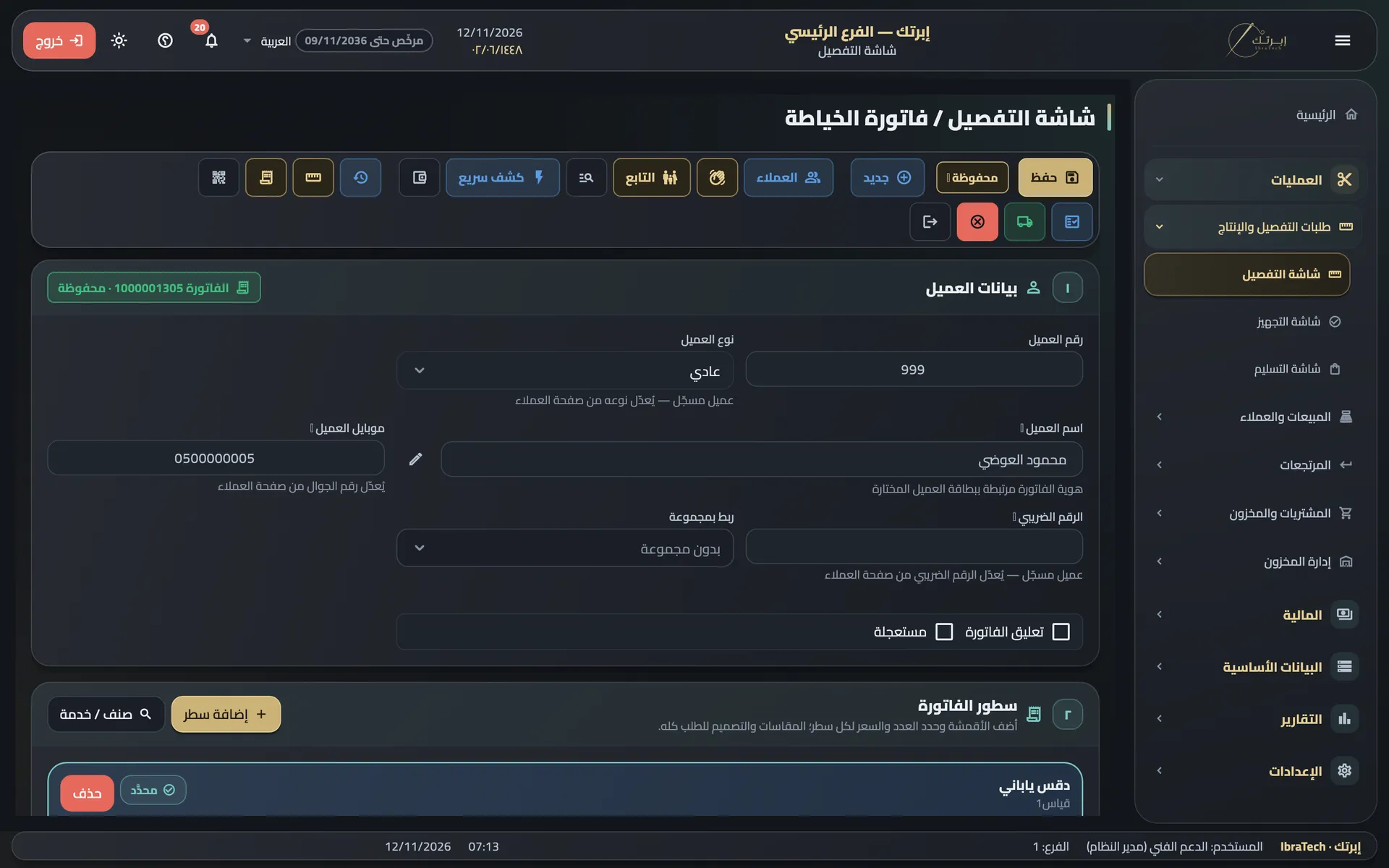
Start with measurements and design, because they are the reason the program exists. It should keep each customer's measurements once and bring them back on the next order, allow measurements for family members under one mobile number, and let you choose the collar, cuff and pocket design by picture instead of a written description that can be misread. Ask about the printed measurement card that travels with the fabric to the workshop.
Then order tracking. After an order is taken you should know at any moment where each piece is: with the cutter, with the tailor, ready, or delivered. Good software shows late orders and each order's delivery date, works out tailors' piece-rate earnings if that is how you pay them, and tells the customer on WhatsApp that the order is ready without a staff member calling every customer.
Then money and stock. The deposit and the balance should appear on the tailoring invoice itself, with receipt vouchers and a daily cash report that matches the drawer. If you sell fabric, ghutras and ready-made items, you need a point of sale and stock that goes down with every sale, plus purchases and suppliers. Ask to see the actual reports: sales, late orders, the customer statement and debt ageing.
Finally, what is specific to Saudi Arabia. An Arabic interface is the baseline, and a language the workshop staff read, such as Urdu, reduces mistakes. Ask about e-invoicing under ZATCA's requirements, and confirm with ZATCA itself which phase applies to your business. Ask what happens when the internet drops: does selling stop, or does work continue and sync later? Try the receipt printer and barcode scanner you already own.
What tailoring software costs
The advertised price is only part of the cost. Add up the whole first year: installation and setup fees, the monthly or yearly subscription, whether it is charged per branch or per user, message packages if there are any, moving your old data, training, and any new devices or printers. Ask each supplier to write these items down one by one, because two offers with the same monthly price can differ widely once the items are added.
An example with published figures: IbraTech's listed prices are SAR 500 for installation, paid once, then a basic subscription of SAR 50 a month or SAR 500 a year that includes sending messages through free WhatsApp. A shop that wants to send from the program directly through the WhatsApp API chooses the SAR 100 a month package with 250 messages, or the SAR 200 a month package with 2,500 messages. Prices exclude VAT.
| Package | Price | Includes |
|---|---|---|
| Setup and installation | SAR 500, once | Paid once when the subscription starts |
| Basic | SAR 50 a month, or SAR 500 a year | The full program, with messages sent through free WhatsApp |
| WhatsApp API | SAR 100 a month | Everything in Basic, plus 250 WhatsApp API messages a month |
| WhatsApp API Plus | SAR 200 a month | Everything in Basic, plus 2,500 WhatsApp API messages a month |
Where IbraTech fits
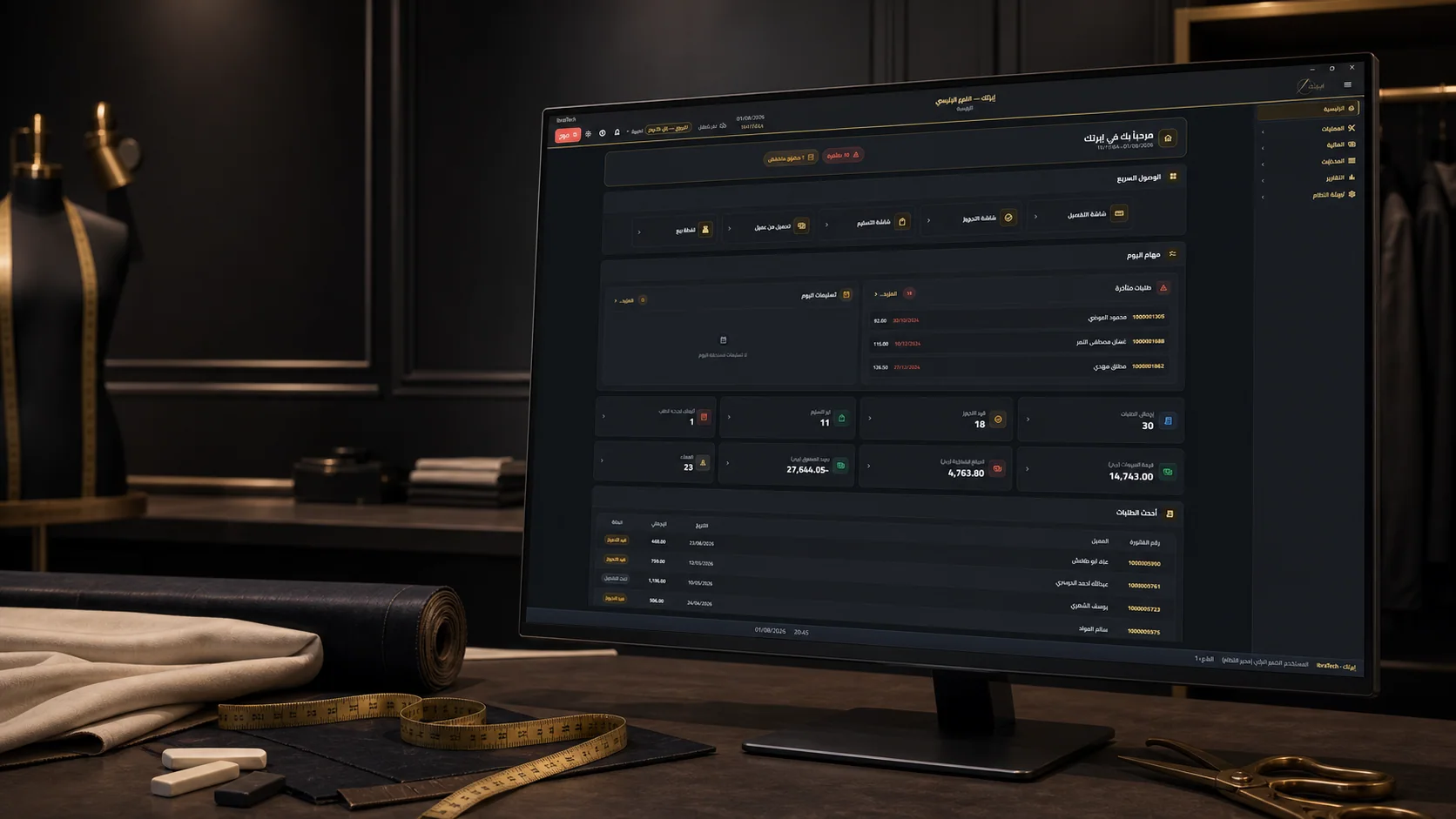
IbraTech is the first kind: dedicated tailoring software for men's tailoring shops in Saudi Arabia. It runs on Windows and macOS computers, keeps working without internet and syncs when the connection returns. It has 136 ready thobe designs chosen by picture, 25 reports, an interface in Arabic, English and Urdu, and e-invoicing that follows ZATCA's requirements.
It is not for everyone. If you are looking for a program to draw patterns or embroidery, that is a different kind of software. If your business is a garment factory with production lines, or you have very particular procedures that ready software does not cover, a custom system may suit you better. The safest test is to watch your own workflow carried out in front of you before you decide.
How to decide
Write your day on one page: how an order is taken, who cuts, who sews, how it is delivered and how the balance is collected. Pick two or three programs and ask each supplier for a demonstration that runs one of your real orders. Our demo checklist gives you a ready list of what to ask for. Then compare the first-year cost, and make sure you can export your data and back it up.
If you want to see IbraTech, its product page shows the screens and the packages, and you can ask for a demonstration on your own shop's orders. If the comparison shows that another program suits your shop better, this guide has still done its job.
Sources
Related services
See IbraTech with your shop’s workflow
Bring your measurement, order, stock and branch requirements to a tailored product demonstration.